
Packaging is an important part of almost every business today. Whether a company sells food products, medicines, electronics, cosmetics, automobile parts, or products through e-commerce, the right packaging helps protect products during storage and transportation.
Among the many packaging options available, corrugated boxes are one of the most commonly used solutions. They are lightweight, strong, customizable, and suitable for a wide range of products.
Businesses looking for Corrugated Packaging Boxes Baddi often need packaging that can handle transportation while also providing a professional appearance. Corrugated boxes can be designed in different sizes, thicknesses, and styles according to the product and shipping requirements.
In this guide, we will explain what corrugated boxes are, their types, uses, benefits, printing options, and why choosing the right packaging manufacturer matters.
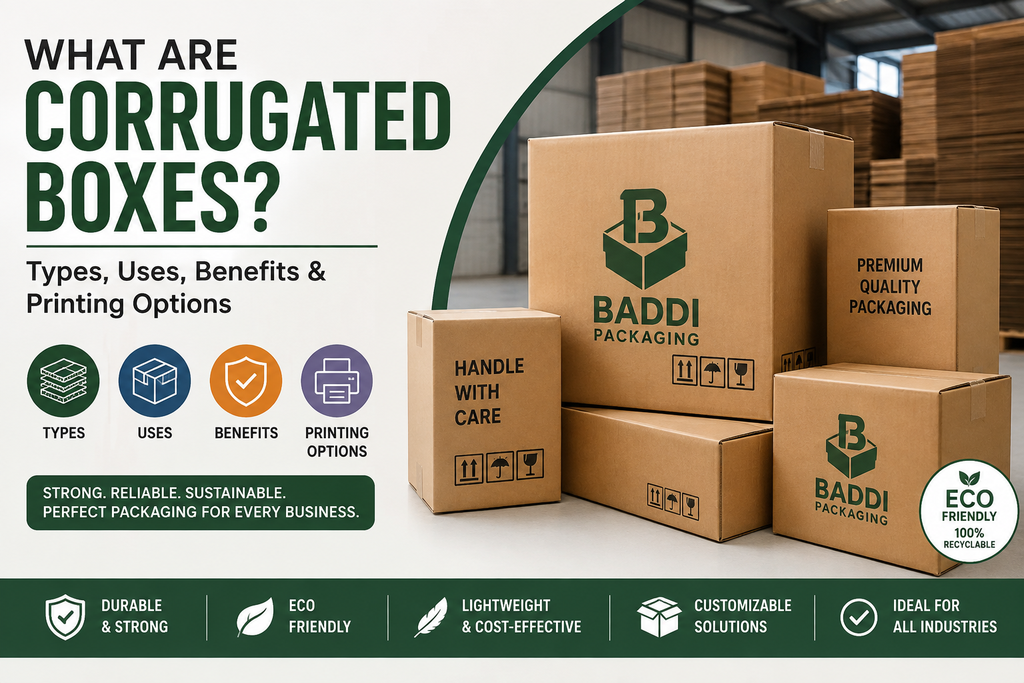
What Are Corrugated Boxes?
Corrugated boxes are packaging boxes made from corrugated cardboard. Unlike ordinary paperboard, corrugated material has a fluted layer between sheets of paper.
This structure gives the box additional strength while keeping its weight relatively low.
A typical corrugated board consists of:
- Outer liner: The outside paper layer
- Fluting: The wavy middle layer
- Inner liner: The inside paper layer
Depending on the required strength, corrugated board can have different numbers of layers.
For example, single-wall corrugated board generally contains one fluted layer between two liner sheets. Double-wall and triple-wall boards contain additional layers and are used when greater strength is required.
This makes corrugated boxes suitable for everything from lightweight retail product to heavier industrial goods.
How Are Corrugated Boxes Made?
The manufacturing process starts with paper reels that are converted into corrugated sheets.
The basic process includes:
1. Paper Preparation
Paper used for liners and fluting is prepared according to the required specifications. Recycled fibers and virgin fibers can both be used depending on the application.
2. Fluting
A sheet of paper is passed through corrugating rollers to create the characteristic wave-shaped flute.
3. Gluing
Starch-based adhesive is applied to join the fluted paper with the liner sheets.
4. Board Formation
The layers are combined to create a strong corrugated board.
5. Cutting and Creasing
The board is cut and creased according to the required box size and design.
6. Printing and Finishing
If branding or product information is required, the box can be printed before the final folding and assembly stage.
7. Folding and Stitching/Gluing
Finally, the box is folded and joined using suitable methods to create the finished packaging.
Types of Corrugated Boxes
Different products require different packaging strengths and designs. Some common types include:
1. Single-Wall Corrugated Boxes
These boxes have one fluted layer and are suitable for many everyday packaging requirements.
They are commonly used for:
- Retail products
- Food packaging
- E-commerce shipments
- Household products
- Lightweight industrial goods
2. Double-Wall Corrugated Boxes
Double-wall boxes contain two fluted layers. They offer additional strength and protection compared with standard single-wall boxes.
They can be useful for heavier products, longer-distance transportation, and products requiring additional stacking strength.
3. Triple-Wall Corrugated Boxes
Triple-wall corrugated packaging provides even greater structural strength.
These boxes are generally used for demanding industrial applications and heavy products where ordinary packaging may not provide sufficient protection.
4. Die-Cut Corrugated Boxes
Die-cut boxes are manufactured according to a specific shape or design.
They can include special openings, locking mechanisms, handles, or customized dimensions.
5. Printed Corrugated Boxes
Printed boxes allow businesses to display:
- Brand name
- Logo
- Product information
- Handling instructions
- Contact details
- Product specifications
- Marketing messages
This turns packaging into more than just a protective layer—it can also become part of the brand experience.
Common Uses of Corrugated Boxes
Corrugated boxes are used across many industries because they can be customized according to product size, weight, and transportation requirements.
E-Commerce
Online businesses depend heavily on shipping boxes. Corrugated packaging helps protect products while they move through warehouses, courier networks, and last-mile delivery.
Food and Agriculture
Corrugated boxes and trays are widely used for fruits, vegetables, food products, and other agricultural goods.
According to FEFCO, around 40% of corrugated packaging in Europe is used for food products.
Pharmaceutical Products
Pharmaceutical and healthcare products require packaging that can provide protection during transportation and storage.
Electronics
Electronics can be sensitive to impact and vibration. Properly designed corrugated packaging can provide cushioning and structural protection.
Automobile and Industrial Products
Manufacturers use stronger corrugated boxes for components, spare parts, machinery accessories, and other industrial products.
For businesses searching for a Corrugated Boxes Manufacturer in Baddi, selecting the board strength and box design according to the product is particularly important.
Benefits of Corrugated Boxes
Strong Yet Lightweight
One of the biggest advantages of corrugated packaging is its strength-to-weight ratio.
The fluted structure provides additional rigidity without requiring a very heavy material.
FEFCO notes that corrugated packaging is designed to provide protection from impacts, vibration, compression, and other transportation conditions while remaining lightweight.
Easy to Customize
Corrugated boxes can be manufactured in different:
- Lengths
- Widths
- Heights
- Board strengths
- Shapes
- Printing designs
- Closure styles
This allows businesses to select packaging according to their specific requirements.
Good for Transportation
Boxes can be designed to stack efficiently, helping businesses organize products during storage and transportation.
The right box dimensions can also reduce unnecessary empty space and improve handling.
Recyclable Material
Corrugated packaging is paper-based and can be recycled through established paper recycling systems.
FEFCO’s 2025 recyclability guidance states that corrugated packaging can be recycled and notes that its fibers can be recycled more than 25 times under suitable recycling conditions.
Supports Branding
Printed corrugated boxes can help businesses communicate their brand identity directly through packaging.
A simple logo, company name, product information, or handling instruction can make the packaging more useful and professional.
Corrugated Packaging Statistics You Should Know
Here are a few useful industry statistics:
- FEFCO reports approximately 49 billion square metres of corrugated board produced annually in Europe in its 2024 industry statistics.
- More than 40% of corrugated packaging is used for food products in Europe.
- FEFCO reports that corrugated packaging protects more than 75% of goods transported in Europe.
- Around 88% of the raw material for new corrugated packaging comes from recycled content, according to FEFCO.
- FEFCO’s current guidance states that corrugated fibers can be recycled more than 25 times without significant loss in quality under suitable conditions.
These statistics demonstrate how widely corrugated packaging is used and why it remains an important packaging material.
Printing Options for Corrugated Boxes
Printing can make corrugated packaging more informative and visually attractive.
Depending on the packaging requirement, businesses can choose different printing approaches.
Flexographic Printing
Flexographic printing is commonly used for corrugated packaging. It can be suitable for printing logos, text, symbols, and simple graphics.
Digital Printing
Digital printing provides flexibility for customized packaging, short production runs, variable designs, and detailed graphics.
One-Color Printing
Businesses that need basic branding can choose simple one-color printing.
This can include the company logo, product name, handling instructions, or basic information.
Multi-Color Printing
For companies that want more visual branding, multi-color printing can be used to create a stronger packaging presentation.
Corrugated Packaging Boxes Baddi for Different Business Needs
Businesses in and around Baddi have different packaging requirements depending on their products and industries.
A small manufacturer may need compact shipping boxes, while an industrial company may require heavy-duty packaging.
Similarly, an e-commerce company may need boxes designed for courier handling, while an agricultural business may need packaging suitable for fruits and vegetables.
For this reason, choosing Corrugated Packaging Boxes Baddi should not be based only on price. Businesses should also consider:
- Product weight
- Product dimensions
- Transportation distance
- Storage conditions
- Required board strength
- Printing requirements
- Box style
- Order quantity
Choosing the right specifications can help reduce product damage and unnecessary packaging costs.
Choosing a Corrugated Boxes Manufacturer in Baddi
Before selecting a packaging supplier, businesses should consider several factors.
Manufacturing Quality
The manufacturer should have appropriate processes for maintaining consistent board and box quality.
Customization
A good packaging supplier should be able to provide different sizes, board strengths, and printing options according to the customer’s requirements.
Production Capacity
For regular business orders, production capacity and supply consistency are important.
Printing Capability
If packaging is part of your branding strategy, check whether the supplier can provide the required printing quality.
Delivery and Location
For businesses operating around Baddi, choosing a nearby supplier can simplify communication, transportation, and regular supply.
This is one reason businesses searching for a Corrugated Boxes Manufacturer in Baddi should consider both product quality and supply reliability.
Corrugated Packaging Boxes Panchkula: What Should Businesses Consider?
Businesses in Panchkula and nearby areas may also require corrugated packaging for manufacturing, retail, e-commerce, food, and industrial applications.
When sourcing Corrugated Packaging Boxes Panchkula, businesses should clearly communicate their product dimensions and packaging requirements to the supplier.
Important specifications include:
- Internal box dimensions
- Board type
- GSM
- Flute type
- Number of layers
- Printing requirements
- Quantity
- Expected transportation conditions
Providing these details helps the manufacturer recommend a suitable box instead of using a one-size-fits-all solution.
Corrugated Boxes in Baddi for Industrial and Commercial Use
Baddi is an important industrial area, and businesses operating here can require packaging for a wide variety of products.
Corrugated Boxes in Baddi can be used for manufacturing, warehousing, transportation, retail distribution, and e-commerce shipments.
For industrial packaging, box strength is especially important. The packaging should be selected based on the product’s weight, stacking requirements, transportation method, and expected handling conditions.
Using the right corrugated board can help provide better protection without unnecessarily increasing packaging material.
How to Choose the Right Corrugated Box?
Before ordering boxes, ask these simple questions:
What is the product weight?
Heavy products may require stronger board construction.
What are the product dimensions?
The box should fit the product appropriately without excessive empty space.
How far will the product travel?
Long-distance shipping may require stronger packaging than short-distance transportation.
Does the product require branding?
If yes, consider suitable printing options.
Will boxes be stacked?
If boxes will be stacked in warehouses or during transportation, compression strength becomes important.
How many boxes are required?
Order quantity can influence production planning and pricing.
Why Proper Box Design Matters
A corrugated box is not simply a container. Its design can influence product protection, transportation efficiency, storage, and presentation.
An oversized box may require additional filling material, while a box that is too small may put pressure on the product.
The goal is to create packaging that is appropriately sized, sufficiently strong, easy to handle, and practical for transportation.
Conclusion
Corrugated boxes have become an important packaging solution because they combine strength, flexibility, customization, and recyclability. From e-commerce shipments and food products to industrial components, they can be designed for many different applications.
Businesses looking for Corrugated Packaging Boxes Baddi, Corrugated Boxes Manufacturer in Baddi, or Corrugated Packaging Boxes Panchkula should focus on factors such as board strength, box dimensions, printing requirements, product weight, and transportation conditions.
For businesses that need reliable Corrugated Boxes in Baddi, Baddi Packaging provides packaging solutions designed around different commercial and industrial requirements. The right packaging approach can help protect products while also creating a professional presentation for customers.
Frequently Asked Questions
1. What are corrugated boxes?
Corrugated boxes are packaging boxes made from corrugated cardboard, which generally consists of liner sheets and a fluted middle layer. This construction provides strength while keeping the box relatively lightweight.
2. Are corrugated boxes recyclable?
Yes. Corrugated packaging is paper-based and can be recycled through appropriate paper recycling systems. FEFCO reports that corrugated fibers can be recycled more than 25 times under suitable conditions.
3. What are corrugated boxes used for?
Corrugated boxes are used for e-commerce, food products, agriculture, pharmaceuticals, electronics, retail products, automobile components, and industrial goods.
4. Can corrugated boxes be printed?
Yes. Corrugated boxes can be printed with company logos, product information, handling symbols, branding, and other graphics.
5. How do I choose the right corrugated box?
Consider the product’s size, weight, fragility, transportation distance, stacking conditions, printing requirements, and storage environment before selecting the box.
6. Where can I get Corrugated Packaging Boxes Baddi?
Businesses can contact local packaging manufacturers and suppliers in the Baddi industrial area to discuss their required box size, board strength, quantity, and printing specifications.
7. What is the difference between single-wall and double-wall boxes?
A single-wall box generally contains one fluted layer, while a double-wall box contains two. Double-wall construction can provide additional strength for heavier or more demanding applications.
8. Can corrugated boxes be customized?
Yes. Corrugated boxes can be customized in terms of dimensions, board construction, box style, printing, and finishing according to the product and business requirements.
9. Why is corrugated packaging popular for e-commerce?
Corrugated packaging is lightweight, stackable, customizable, and capable of providing protection during transportation, making it widely used for e-commerce shipping.
10. What information should I give a packaging manufacturer?
Provide the product dimensions, weight, quantity, box style, printing requirements, expected transportation conditions, and any special protection requirements. This helps the manufacturer recommend suitable packaging specifications.